
Quality and Standards
Conformity of our products is verified through burst pressure, impulse life and dimensional tolerance measurements.
Our Quality Policy
The safety of a hydraulic connection component directly affects the safety of the machine it works on and of its operator. We apply the following principles across every product group we supply.
Standards Compliance
Our products are classified to the DIN EN and SAE 100 series standards. The reinforcement class and pressure figures shown on the product label match the goods delivered exactly.
Supplier Assessment
We assess our manufacturing partners on line infrastructure, test equipment and production continuity, and work with them long term.
Incoming Inspection
On every batch received into the warehouse, thread size, seat angle and inner diameter are verified on a sample basis using calipers and gauges.
Batch Traceability
Shipments are recorded against a batch number. On request, the test certificate and technical data sheet for that batch are provided.
Correct Product Guidance
We never recommend a lower class than the application requires, and equally never steer customers towards an unnecessarily high one.
Safety Factor
Hydraulic hose standards require burst pressure (BP) to be at least four times working pressure (WP). That margin is defined to cover pressure spikes in the system, temperature variation and fatigue accumulated over time.
As an example, a 2SN hose labelled at 415 bar working pressure must have a burst pressure of at least 1,660 bar. A product that fails to meet this ratio is not considered compliant, even if its dimensions are correct.
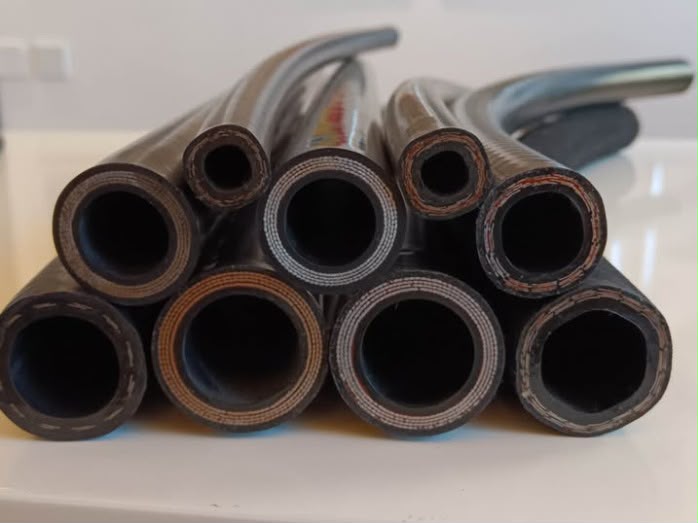
Working and Burst Pressure
Burst pressure values reflect the minimum standard requirement of four times the working pressure.
| Hose | Inner diameter | Working pressure | Min. burst pressure |
|---|---|---|---|
| DIN EN 853 1SN | 1/4″ | 225 bar | 900 bar |
| DIN EN 853 2SN | 1/2″ | 275 bar | 1.100 bar |
| DIN EN 857 2SC | 5/16″ | 350 bar | 1.400 bar |
| DIN EN 856 4SP | 3/8″ | 445 bar | 1.780 bar |
| SAE 100 R15 | 3/4″ | 420 bar | 1.680 bar |
Test Methods
Standards define not only dimensional values but also the tests a product must pass.
| Test | Application | Acceptance criterion |
|---|---|---|
| Burst test | The sample is burst by raising pressure in stages. | The measured value must not fall below the minimum burst pressure required by the standard. |
| Impulse test | Pressure is cycled up and down to measure fatigue life. | 150,000 – 500,000 cycles are completed depending on reinforcement class. |
| Leak test | The crimped hose assembly is held at 1.5 times working pressure. | No dripping or permanent change in diameter is observed. |
| Dimensional inspection | Inner diameter, outer diameter, thread size and seat angle are measured with calipers and gauges. | Values stay within the tolerance range of the standard. |
Reference Standards
| Standard | Scope | Product group |
|---|---|---|
| DIN EN 853 | Steel wire braid reinforced hydraulic hoses (1SN, 2SN) | Hose |
| DIN EN 856 | Steel wire spiral reinforced hydraulic hoses (4SP, 4SH) | Hose |
| DIN EN 857 | Compact hoses with a tight bend radius (1SC, 2SC) | Hose |
| SAE J517 / 100 R | American hydraulic hose classes (R1AT, R2AT, R3, R15) | Hose |
| ISO 8434-1 | 24° cone metric connections (DIN 2353 L/S series) | Fitting |
| ISO 8434-2 | 37° flare JIC connections (SAE J514) | Fitting |
| ISO 8434-3 | O-ring face seal ORFS connections (SAE J1453) | Fitting |
| ISO 228 / BS 5200 | Parallel pipe thread (BSP) with a 60° cone seat | Fitting |
| ISO 6162 / SAE J518 | Flange connections — Code 61 and Code 62 | Fitting |
| ISO 1436 | Hydraulic hose test methods | Test |
| ISO 8331 | Selecting, assembling and using a hose assembly | Application |
Batch test certificates are available on request — just mention it when ordering.
Storage and Handling
Rubber hardens over time. Hoses that are not stored under suitable conditions lose their service life even if they are never used.
Cool, Dark Storage
Direct sunlight and temperatures above 40 °C accelerate ageing of the rubber. The recommended storage temperature is 15–25 °C.
Store Without Kinks
Coils must be wound so the hose never drops below its minimum bend radius. A permanent kink causes fatigue in the reinforcement layer.
Away From Ozone and Solvents
Electric motors release ozone. Welding bays and solvent stores should not be located near hose racking.
Twist During Assembly
Twisting the hose about its own axis reduces its pressure rating markedly. The printed lay line on the surface must stay straight.
Length Allowance
A hose can change length by up to 2% under pressure. Fitting it taut leads to failure at the fitting outlet.
Abrasion Protection
Use a spiral guard or clamp on hoses that contact moving parts or sharp edges.
When to Replace a Hose
A burst hydraulic hose can cause serious injury through high-pressure oil injection. The hose must be replaced as soon as any of the following signs appear.
-
Cuts or cracks in the outer cover, or exposed steel wire
-
Weeping around the fitting or signs of slippage on the ferrule
-
Swelling or blistering of the hose body
-
Hardening, loss of flexibility or fine surface cracking
-
Crushing, a permanent kink or signs of twisting
-
Corrosion on the fitting or a joint that has worked loose
Safety note: Never check a pressurised hose by hand. Even a pinhole leak carries enough force to penetrate skin. Use a piece of cardboard to locate leaks, and never work on the line before system pressure has been released.
Certificate or technical document request
We can send batch test certificates and product data sheets.